






 7 Min
7 Min
 Zuletzt aktualisiert am 23.09.2026

Creatine is currently on everyone's lips – literally. And although most of us probably know that creatine plays an important role for muscles, many don't really know what creatine actually is. This article will find out exactly that together, so you can join the conversation at your next gym session.
So, what is creatine anyway? And what do dinosaurs have to do with it?!
Your knowledge to go: What is creatine?
-
Creatine is produced with the help of amino acids and naturally occurs in our body.
-
Creatine can be produced by the body itself and obtained through animal products or supplements.
-
An intake of up to 3 g/day is considered safe for healthy adults.
What is creatine simply explained?
Creatine is a carbon-nitrogen compound. What? That doesn't really make us any wiser. What does that mean? What is creatine simply explained?
Creatine is a substance formed with the help of amino acids (the building blocks of proteins) and plays an important role in the energy metabolism of muscles. There, creatine (very simply put) ensures a good energy supply for our muscles.
Let's briefly return to the technical term: carbon-nitrogen compound sounds complicated, but you know other examples: proteins and our DNA also belong to this group. Clear?
Adults use an estimated 1.5-2 grams of creatine per day .
Creatine is produced by the human body itself. It requires the amino acids arginine, methionine, and glycine. Let's take a quick look at how this works. Don't worry, we won't dive deep into biochemistry now. Afterwards, we'll also better understand what creatine is – promised.
Creatine is formed in the liver from a substance called guanidinoacetate with the help of methionine. Oh, here is our dino too... less spectacular than expected. Guanidinoacetate is in turn produced from the amino acids glycine and arginine in the pancreas and kidneys. Additionally, creatine can also be obtained through diet with meat and fish.
The produced (or food-derived) creatine goes on a journey through our body: from the intestine or liver it enters the blood and from there to the body areas where creatine is needed. The most important target is our skeletal muscle. About 90% of the creatine is stored there as Creatine phosphate stored. The remaining 10% is transported to other areas such as our brain.
Good to know: creatine phosphate
(also PCr or phosphocreatine):
Creatine phosphate is a compound of creatine and phosphate – creatine has basically adopted a phosphate group.
We have now clarified the question of what creatine is. But what is creatine or creatine? Simply put: it's all the same!
Time to focus on more important topics:
What does creatine do in the body – properties and effects
We have now found out what creatine is. And you often hear that creatine is good. But what does it do in our body?
Basically, our muscles need creatine because creatine phosphate is an energy supplier. Many athletes use creatine to try to build muscle effectively. This is probably the most well-known function.
However, there is also research on other areas of use; so far without approved health claims:
-
brain
-
nervous system
-
mental health
-
immune system
You notice, creatine is important for our body. For this reason, an adult has a creatine store of about 120-150 g to always have enough creatine in reserve!
Creatine in sports – training and performance
Creatine is considered a gamechanger in sports on the internet and promises better performance in training. What's the truth behind it?
Creatine can provide energy to our muscles very quickly and increases physical performance in explosive strength training during short-term intense physical activity. The positive effect occurs with a daily intake of 3 g of creatine. Some studies are currently also investigating whether creatine might play a role in recovery, muscle soreness or injury risks. However, the results are so far inconsistent and no confirmed effect. How all this works, what role type 2 muscle fibers play, and what else creatine can do, I explain in more detail in the blog post "What Does Creatine Do?". There you will also learn more about the benefits and effects of creatine.
Creatine and Our Kidneys
There is a connection between creatine and our kidneys. Not only are the building blocks for creatine produced there – the kidneys are also responsible for converting creatine to creatinine and excreting it through urine. By the way: Sometimes the creatinine level is measured by the doctor – maybe the term sounds familiar to you.
Whether creatine (as often assumed) is harmful to our kidneys, we will find out later!
Creatine in Nutrition
We have now slowly understood what creatine is and what it does. At least my head is already spinning. But how can we take it in? In what is creatine contained?
Creatine is mainly found in our diet in meat and fish. The name already shows this: Creatine comes from the ancient Greek word for meat. But (cow) milk can also be seen as a source of creatine. However, it contains significantly less creatine than meat.
Bad news for vegetarians and vegans: Creatine is hardly found in fruits and vegetables. What now?
Creatine in Vegetarian and Vegan Nutrition
As already mentioned, creatine is mainly found in animal products. This poses a big question for people with a vegetarian or vegan diet: how do they get enough creatine? Where does the substance come from in a plant-based diet? Or does their body have to work overtime to produce more creatine itself?
In short: Yes. People who take in little creatine from food simply produce it themselves. This is not a problem – the body (to cover the absolute basic needs) is usually not dependent on intake through diet and can cover most of its needs itself. Creatine from food is practically an “extra”.
You just have to make sure that the essential amino acid methionine, which is necessary for the production of creatine, is taken in sufficient amounts. Because without it, no creatine can be formed!
Vegetarian and vegan people often have slightly lower creatine stores. So if you want to take additional creatine to fill your stores and make quick progress in sports, supplementation could be interesting for you.
%-product_content-%
Creatine Supplementation
Especially for active athletes, but also for vegetarian and vegan people, creatine is becoming more and more of a focus and many already take creatine supplements.
Is it even necessary? Especially if you are currently under a lot of stress, do not eat ideally or plant-based, or do a lot of demanding sports, a creatine supplementation can be interesting.
If you want to read more about creatine supplementation, I can recommend our articles on creatine intake and on timing of supplementation. There you will find all the important information and also the answer to the question of how much creatine you should take per kg.
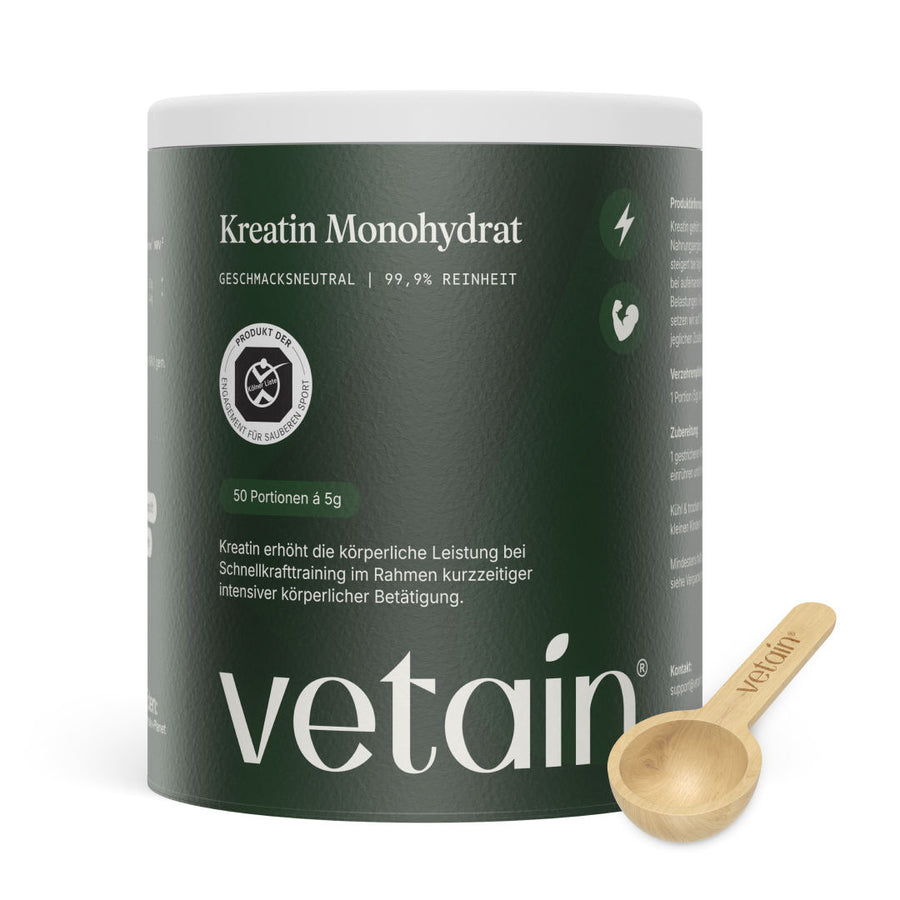
And you can also find the right creatine supplement with us.
%-split_content-%
Risks and disadvantages of creatine
Time and again, you read warnings and frightening side effects of creatine on the internet. Many are still concerned whether taking creatine is really safe. We understand that! When you don't know something and can't assess it, it is unsettling. But that's why we're here to give you an honest and scientific assessment.
By the way: You can trust that in our shop for protein powders and supplements we will always offer only safe products – your health and well-being are our top priority!
But let's get back to the topic:
Does creatine have side effects?
There are individual reports of side effects – of course, why should it be different with creatine than with other foods. There is probably always someone in our world who cannot tolerate a product. After all, there is even an allergy to water!
Meanwhile, several large and comprehensive studies have looked into the matter and have good news: side effects are rare. See for yourself:
Possible side effects in rare, individual cases and at very high doses (more than the recommendation):
-
Bloating
-
mild diarrhea
-
Muscle cramps
So if you follow the recommendation and choose a high-quality creatine supplement, side effects are rare.
What can happen, however, is that you gain some weight because creatine promotes water retention in the muscles. This leads to the well-known phenomenon of muscles looking full and pumped! Whether this is an unwanted side effect or rather an advantage is up to each individual.
Safety of creatine: scientific evaluation
Is creatine harmful? The European Food Safety Authority (EFSA) confirmed more than 20 years ago that daily supplementation of up to 3 g of creatine is safe for adults. Of course, this assumes you are healthy and your creatine is free from heavy metals and other contaminants. Therefore, as mentioned, be sure to pay attention to good quality.
Other large and representative studies have also found no harmful effects of creatine supplementation over both short and longer periods, provided the intake recommendations are followed.
Creatine is also not supposed to negatively affect the kidneys of healthy people when taken in the recommended amount. However, if you suffer from diseases that affect your kidneys or could impact them, you should seek medical advice before supplementation.
Once you understand what creatine is, this assessment also makes sense; after all, it is just amino acids in a different form.
Conclusion: Creatine at a glance
Here again all the information at a glance, so you can easily answer the question "What is creatine?" in the future: Creatine is a substance in our body that is formed with the help of amino acids. Creatine plays an important role in many areas and processes in our body. It is best known for its significance in sports! Creatine is considered well tolerated at the recommended dosage.
Give it a try and tell us about your experiences!
Literature & sources
-
EFSA NDA Panel (EFSA Panel on Dietetic Products, Nutrition and Allergies) (2016). Scientific opinion on creatine in combination with resistance training and improvement in muscle strength: evaluation of a health claim pursuant to Article 13(5) of Regulation (EC) No 1924/2006. In: EFSA Journal, 14(2).
-
Kreider, R. B. et al. (2017). International Society of Sports Nutrition position stand: safety and efficacy of creatine supplementation in exercise, sport, and medicine. In: Journal of the International Society of Sports Nutrition, 14(1).
-
Swiss Sports Nutrition Society (2023). Supplement Guide. A-Supplements: Performance Supplement. https://www.ssns.ch/wp-content/uploads/2023/12/SSNS-SG-Kreatin_V2.2.pdf
Do you have questions? Then feel free to write me one Email – I look forward to hearing from you! :)
The information shared in this article does not replace individual medical or nutritional advice.